
The Bridge You Didn't Know You Built
The practice rooms at the back of the arts block were meant for musicians. You were supposed to sign out a key from the office, log your name in the register, have a purpose. Daniel had done it properly the first time: asked Mrs Doyle, the head of music, whether he could use one of the rooms at lunch. She'd looked at him for a moment, long enough to be evaluating something he hadn't said out loud, and told him room seven was free most days. She didn't ask what he was working on.
He wasn't working on anything.
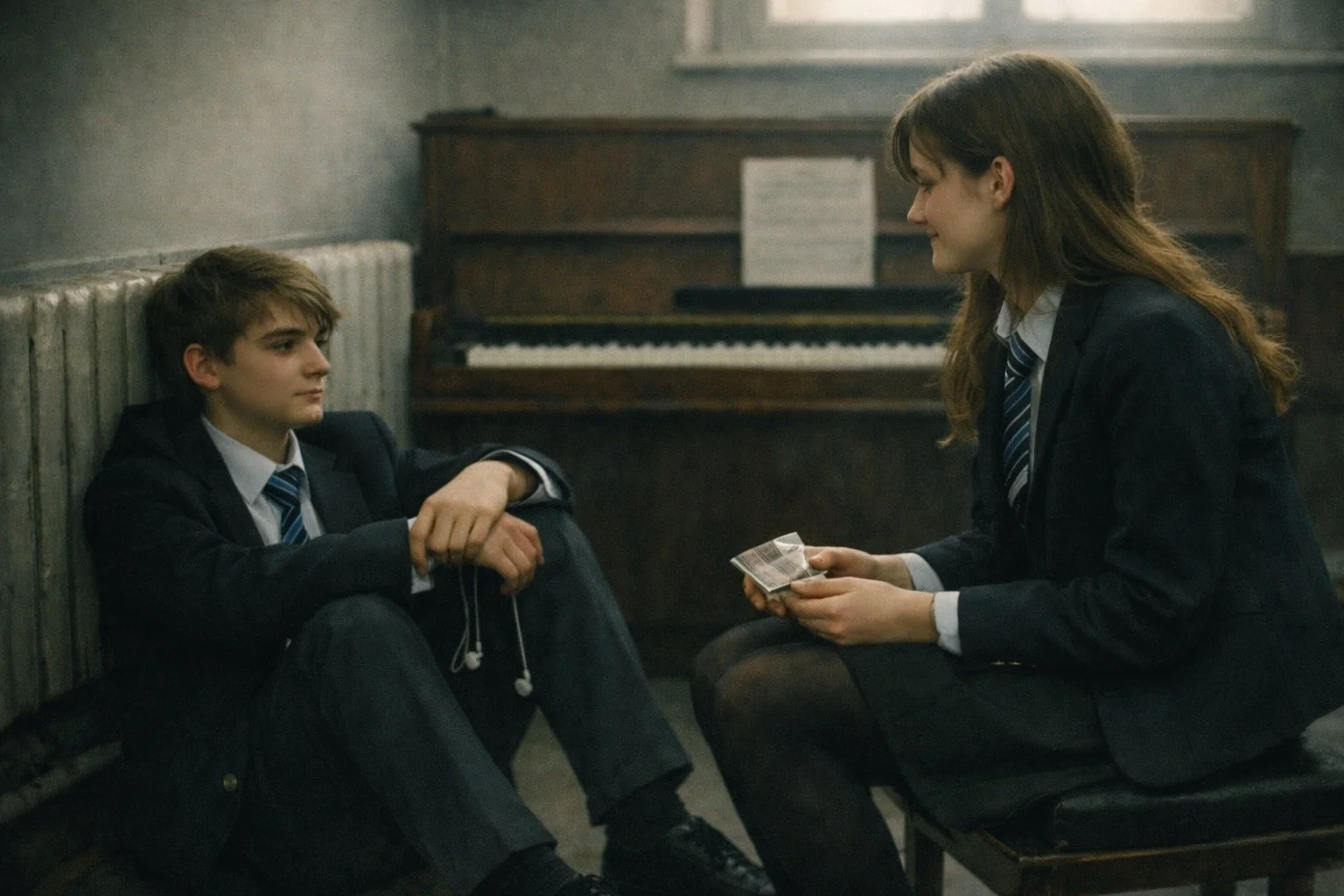
He sat on the floor with his back against the radiator, which didn't work, and ate his sandwich in twelve careful bites. The piano stood in the corner with the lid down. He'd tried it in his first week, one careful hand on the keys, enough to know it was out of tune. The middle register was flat. He'd put the lid back down and not touched it since.
Outside, he could hear the distant percussion of the yard: shouts, a football striking tarmac, a teacher's whistle. It all had the quality of something heard through water. Present but not quite real.
He wasn't hiding. That was what he told himself most firmly. He just preferred quiet. Always had. His mum said it about him when he was small: he's a quiet one, our Daniel. Back then it had seemed like a gentle observation. These days it felt more like a diagnosis.
He had both earbuds in. This was important and intentional. One earbud in was still permeable, a signal that said I might speak to you if pressed. Both earbuds in meant something different: I am not here. Walk past. People generally understood. He'd learned it helped to keep the volume low enough to hear approaching footsteps, but nobody watching would know that.
When the bell went, he packed his lunch box, straightened his tie in the dark rectangle of the window glass, and walked back into the school feeling, as he always did, faintly surprised that the world had continued without him.
Helena Marsh's return went round the school before she'd even arrived. Daniel heard about it the way he heard most things: adjacent to a conversation rather than inside one, standing near the water fountain after lunch while two girls from his form debated what she'd actually been doing in Scotland for a whole year. He registered it the way he registered most things: filed somewhere at the back, behind the more immediate business of getting through the afternoon.
He didn't think about Helena much. He tried not to think about most things.
He pulled both earbuds in as he moved through the corridor toward maths. Both in. Not available. The signal was well established enough by now that even the louder members of his year had stopped trying.
She arrived on a Tuesday. He wasn't there to see it. He was in room seven with his sandwich.
He saw her on Wednesday, outside the science block.
She was standing with Priya Rao, both of them turned toward each other, and he recognised her before he could stop himself. Helena with one hand on Priya's arm the way she always used to do when something was funny, a physical emphasis, an insistence on shared joy. She looked the same. Taller maybe. Hair cut shorter at the sides. But unmistakably herself, which was something he'd forgotten he knew how to identify.
She hadn't seen him. He was on his way to the library and he had approximately four seconds before his current trajectory would take him into her eyeline.
He turned left, behind the bike shed, arrived at the library by a longer route.
He wasn't hiding. He just preferred quiet.
He sat in the library and read the same paragraph in his geography textbook six times without absorbing any of it. His knee was doing the thing it did, the bouncing, the thing his mum said made her anxious just to watch. He pressed his foot flat to the floor and held it there.
He thought about the piano.
He opened his textbook to a different page.
Thursday. Room seven.
He heard footsteps in the corridor that didn't belong to the usual pattern of the building: slower than a teacher's purposeful stride, less certain than a sixth former's easy ownership of the space. He heard the sticky door, the particular resistance of it, and then it opened.
Helena stood in the doorway and looked at him sitting on the floor against the cold radiator with his sandwich and both earbuds in, and didn't say anything for a moment.
He took the earbuds out.
She came in. She sat on the floor a little distance away, near the piano stool, which she dragged across and sat on instead with the unselfconsciousness of someone who'd never spent much time worrying about where to put herself. She produced a packet of crisps from her blazer pocket.
"Mrs Doyle said you'd probably be in here," she said. "I told her I was an old friend. She seemed to think that was sufficient."
Daniel said: "I'm fine."
Helena ate a crisp and didn't argue with this. That was one of the things about her. She didn't argue with the obvious lie; she just left it somewhere between them where they could both see it.
"I've been back two days," she said, "and nobody has told me anything interesting. Tell me something interesting."
"I don't know anything interesting."
"Make something up."
"I don't..." He stopped. She was looking at him with an expression he recognised from years ago: patient, slightly amused, not going anywhere. He said: "The piano's out of tune."
"How do you know? You're not touching it."
"I tried it the first week. The middle register's flat."
She considered this. "That's either interesting or very sad," she said. "I can't decide which."
He almost smiled. It cost him something, almost smiling. He wasn't sure exactly what.
They ate in silence for a while. Outside, the yard did its distant percussion thing. Helena finished her crisps and folded the packet into a neat square and put it back in her blazer pocket. She didn't speak again until the bell went, at which point she stood, replaced the piano stool, and said:
"Same time tomorrow?"
Daniel said nothing.
She took this as yes.
They lived three streets apart. They always had. The walk home from school was twenty-two minutes, which Daniel had timed once, and it was the kind of duration that was either too long or exactly right depending on who you were walking with.
Helena talked. She'd always been a talker, the kind who talked to think rather than talking because they'd already finished. She told him about Scotland: the school there, which had been large and impersonal and not unkind; the landscape, which she'd found genuinely beautiful in a way that surprised her; her mother's partner, who she'd decided she didn't actually dislike even though she'd arrived prepared to. She talked around the difficult bits rather than over them, so you knew they were there.
Daniel listened. He was good at listening.
He had one earbud in on the walk home. This was different from the corridor rule. She'd noticed it the first day and asked about it, and he'd explained the system without quite meaning to: both in meant not available, one in was somewhere between. She'd nodded as though this was entirely reasonable and hadn't mentioned it again.
At the junction of Whitmore Road she asked: "What have you been doing? This year, I mean."
"School," he said.
"Right. And outside school?"
A pause. "Not much."
She glanced at him sidelong. He was looking at the pavement.
"You quit football," she said. It wasn't quite a question.
"Yeah."
"You loved football."
"Yeah."
She didn't push it. But he felt the shape the conversation had made, the outline of the thing neither of them had named. It walked home with them, not said, not quite dismissed, just present.
At the point where their routes diverged, she said: "Tomorrow, then."
He said: "You don't have to."
She said: "I know."
It was Helena who brought it up, in the music room, on a Thursday in October. They were three weeks into the lunchtime arrangement by then, which had acquired a shape: she brought crisps, he had his sandwich, she talked, he listened and occasionally said something that made her laugh, which was a thing he hadn't expected to still be able to do.
She said: "Do you remember when I wouldn't come to school for two weeks in Year Nine?"
He remembered. "You said it was a bug."
"It wasn't a bug."
He waited.
"Things were difficult at home. Mum and Dad, the final stretch of all that." She picked at the edge of her crisp packet. "I wouldn't come out of my room and nobody knew what to do with me. And you sat on the landing outside my door and just talked at me through the wood. For two hours. You weren't saying anything particularly useful. You were telling me about some video game you were playing."
"I remember."
"And eventually I came out because I wanted to know if you'd got past the bit with the bridge."
He was very still.
"You didn't make it better," she said. "You didn't say the right things. You just didn't go away." She looked at him. "That's all this is, Daniel. I'm not going away."
He pressed his back harder against the cold radiator. His throat had done something difficult. He said, eventually: "The bridge was impossible. I never got past it."
"I know," she said. "I watched you die on it eleven times before I came out."
Something broke loose in his chest, not painfully, the way things sometimes did. More like a window unsticking.
He said: "It's been a bad year."
She nodded. She didn't ask how bad.
Not yet.
It came out in pieces, the way it does when you've been holding something a long time and someone patient enough sits close enough for long enough.
His dad had left in January. Not dramatically. No shouting, no single incident. He'd just stopped being fully there across a period of months and then been fully not there, and his mum had cried in the kitchen when she thought Daniel wasn't listening, and Daniel had listened, and the house had gone very quiet in a way that had nothing to do with preference.
The report in March. Not failing, but below expected. Below his own expected. His physics teacher had used the phrase not performing to potential and Daniel had sat with it for weeks, turning it over, the way it contained both a fact and an accusation.
He'd stopped football in April.
He told Helena this in three separate sessions, not as a narrative but in the way you hand someone things, one at a time, testing the weight they're carrying before you add more.
She didn't offer solutions. She asked, occasionally, how things were now. She said once: "Have you told anyone else?" and when he said no she didn't suggest he should, only nodded as though filing it away.
There was a Wednesday in late October when he told her the rest of it. He wasn't sure why that day. Something about the light through the small high window of room seven, or the particular quality of the silence between them.
He said: "In April. When I stopped football. There were a few weeks where I kept having thoughts about... not being here any more."
She didn't move. Didn't change her expression.
"Not like a plan," he said. "Just the thought kept arriving. Like a door I kept walking past."
She said: "Does it still arrive?"
"Sometimes. Less."
"Okay." Then, after a moment: "Thank you for telling me."
He'd expected something different. Alarm, maybe. The particular kind of bright concerned attention that made you feel like a problem being managed. What he got was Helena sitting very still and looking at him steadily, and then saying: "If it gets loud again. You tell me."
Not a question.
He said: "Yeah."
"Whatever time. You tell me."
He said: "I know I should probably talk to someone. Properly."
"You're talking to me."
"You know what I mean."
"Yes," she said. "But this counts. This is not nothing."
The changes were not dramatic and did not happen in order.
In the third week of October he went to football practice. Not a match, just the Tuesday session, which felt lower stakes. He was rusty and Hayes, the coach, said nothing about his absence and put him on the left wing and ran the drill. He was slower than he'd been. He was still there when the whistle went.
He started doing his homework at the kitchen table again instead of his room. His mum said nothing about it, only made him a cup of tea when she made herself one, and this small domesticity was both unremarkable and very important.
He and Helena worked through a set of chemistry past papers one afternoon at the library, Helena complaining throughout that she didn't understand anything because Scotland had done it all in a completely different order. He explained oxidation states three times. On the third attempt he used a metaphor involving library fines that he made up on the spot and she got it immediately.
She looked at him. "That was either a really good explanation or I've been learning chemistry wrong for two years."
"Probably both," he said.
She laughed, the surprised kind, the kind you couldn't manufacture. He filed it somewhere.
He started touching the piano. Not playing, just sitting with his hands on the keys, not pressing down, getting used to the idea of it again. Helena affected not to notice, which was its own kind of consideration.
One day in November he pressed a key. The note came out flat, exactly as he'd known it would, and sat in the air of the room, slightly wrong, and then faded.
"See?" he said. "I told you it was flat."
"You did," Helena said. "That's either interesting or very sad. I still can't decide."
He played a chord. It was out of tune and it was the first thing he'd played in seven months and it filled the room completely.
The maths test came back with a 34% at the top and Mr Farrow's careful handwriting in the margin: Please see me. Daniel folded it in half and put it in his bag and walked out of the classroom feeling very far away from his own body.
He didn't go to room seven at lunch. He went to the yard and stood at the edge of it, which he hadn't done in weeks. The noise felt enormous after months of the practice room's quiet.
That evening his mum asked, as she always did in her careful way, how things had been, and Daniel said fine, and she said she'd had a call from the school (not about the test, about the form tutor, some routine welfare check) and Daniel heard, underneath the careful neutrality of her voice, the worry she always carried and did her best to carry quietly.
He said: "I'm not doing well enough."
She said: "In what?"
"In any of it."
His voice had gone wrong somewhere in that sentence. He hadn't meant it to. He stood up from the table and said he was going out, and she said Daniel... and he said he was fine, he was just going out, and went.
He walked fast, the way he did when his head was too loud, taking corners without a destination, until he found himself at the park, the far end with the benches nobody sat on after dark. The cold came up through the wood and into him.
The door was there. He was aware of it the way he was always aware of it, more present than usual tonight.
He sat for a long time.
His phone was in his pocket. This was a fact he was aware of in a particular way, the way you're aware of something when you're consciously not looking at it.
He could go home. He could sit on the bench until the cold made the decision for him. He could call nobody and say nothing and walk back through his front door and his mum would be awake and would see his face and would not know what to do with it.
Or.
He got his phone out. The screen lit up in the dark.
He opened the conversation with Helena and typed: are you around
Three dots.
Then: yes. where are you
He told her. She sent back: stay there
He sat in the cold. The park was empty. The sky above the street lights was washed-out orange and a fox crossed the path twenty metres away without acknowledging him. He watched it go.
He was still there when Helena arrived, slightly out of breath, her coat done up wrong.
She sat beside him on the bench and for a while neither of them said anything.
He told her about the test. He told her about his mum's face when she asked how things had been. He told her about standing up from the table and not knowing where he was going but needing to go somewhere, and how the park had been the somewhere, and how he'd been sitting here for (he checked his phone) forty minutes.
Helena listened. She was very good at listening when she chose to be.
He said: "I don't know what's wrong with me."
She said: "I don't think anything's wrong with you."
"I failed a test. I walked out on my mum. I've been eating lunch in a cupboard for six weeks."
"Seven," she said. "And it's a practice room."
He almost laughed, which surprised him.
She said: "Is it loud tonight? The door."
He understood what she meant. He'd known she would. He said: "Louder than usual."
She nodded. She didn't move.
"I think you've had a hard year and you've been carrying it on your own and some days it gets too heavy and you need to put it down somewhere." She paused. "You texted me."
"Yeah."
"That's..." She seemed to be choosing the word carefully. "That's different from the cupboard."
He understood what she meant. He sat with it.
The cold was considerable. His hands were in his pockets. Helena had her arms folded and was doing the thing where she made no complaint about a physical discomfort, which he recognised as stubbornness rather than hardiness.
He said: "You should have brought a better coat."
"I know," she said. "I left in a hurry."
"Thank you," he said. "For..." He stopped. He didn't finish the sentence because he didn't know how to finish it and she didn't make him.
She said: "Can we go somewhere warm?"
He said: "Yeah."
They walked back through the park and out onto the street and found the chip shop on Langley Road still open, and sat at the small plastic table by the window with a portion of chips between them, and the warmth came back into him slowly, the way it does.
The following Monday, Daniel went in.
It sounds like it shouldn't be significant, going to school on a Monday. It was not a dramatic entry. He walked in through the gates with the same people who walked in through the gates every morning. He went to form, where Mr Ashford took the register and mispronounced Wojciechowski as he always did and nobody corrected him. He went to double English and answered one question, which was more than usual.
At lunch he went to room seven. Helena was already there, on the piano stool, which she'd claimed as her own over the preceding weeks. She'd brought crisps and an extra packet.
He sat on the floor against the cold radiator and ate his sandwich.
She said: "How's today?"
He said: "Manageable."
She nodded. This was sufficient.
He had an appointment with the school counsellor on Wednesday, and he'd made it himself, which was the part that had felt hardest: the picking up of the phone, the saying of the words I'd like to make an appointment. Three minutes on a Thursday lunchtime two weeks ago that had felt like an enormous expenditure of something. He'd told Helena after.
She'd said: "That's the bridge bit."
He'd said: "What?"
She'd said: "You built it. You crossed it. You just didn't know you were doing it."
He sat in room seven with his sandwich and the out-of-tune piano and the cold radiator that didn't work and Helena eating crisps on the piano stool. Outside, the yard was doing its distant percussion. He was aware of it (the shouts, the tarmac, the whistle) in a way that felt slightly different from September. Less like something heard through water. More like weather: external, real, something you could step out into if you chose to.
He wasn't ready to step out into it yet. That was fine.
He put his hands on the piano keys, not pressing down.
Then he pressed down.
The chord came out flat and imperfect and full.
Word count: approximately 3,350 words










Two girls have named the clouds over Hampstead Heath since they were nine. The summer they turn sixteen, a dazzling first love and a quiet family catastrophe pull them apart. A story about idealism, the hard winter that follows it, and learning what it costs to turn back up for someone.