
We Fix What We Can
I know this street the way you know a place you grew up in: not perfectly, not consciously, but somewhere underneath thought. The slight dip in the pavement outside the newsagent's. The way the smell changes when you pass the bakery, even when it's closed. The sound the wind makes coming off the park in February, lower and more patient than any other month, like it has somewhere to be and isn't rushing.
I used to cycle this street. Past Mr Patel's, past the off-licence, down to the cut-through by the bowling green and out the other side. I could do it without thinking. I did it without thinking, most days, which is the kind of thing you don't know to regret until later.
I notice things. I always noticed things. It was the one skill I had that nobody gave marks for, and it turns out you keep what you are.
So I'm noticing the smell of the fire before I see what's left of it. Smoke and wet stone and underneath it something almost sweet, the ghost of whatever was good and ordinary in that building burned down to its last trace. And I notice, before I notice anything else, Leila.
You're going to ask me something. I can already feel the question forming. Not yet. Watch her first. She's worth watching.
* * *
Leila is fifteen and you might not notice her if you passed her, which is partly the point and partly the thing she's fighting without knowing she's fighting it. She's been standing on the opposite pavement for twenty minutes with her school bag still on her shoulder and she's crossed the road twice in her head and talked herself back both times.
You know that feeling, I think. The voice that says it isn't your place, you'll only make it worse, better to stay small and ask nothing of the world and have nothing asked of you in return. It's a convincing voice. It sounds like wisdom sometimes. It sounds like sense. It takes a while to understand that it's just fear wearing sensible clothes.
Leila has been listening to it for years. She has a particular way of going still when it speaks, a kind of internal bracing, and then a particular way of breathing before she decides to move anyway. I know both of these things the way you know the habits of someone you've shared a house with, someone whose nightmares you've sat through, someone whose small particular ways have become so familiar you stop seeing them.
The way she folds her hands when she's anxious. The way she breathes before she speaks, steadying something only she can feel the shape of. She's been doing that since she was small.
She steadies herself now. And then she does something that costs her more than it looks like it costs.
She goes to the off-licence. She buys a bottle of water. She crosses the road.
Mr Patel is sitting on the low wall outside with his hands folded in his lap and the crowd is doing what crowds do: gathered, filmed, murmured, and not approached. I think about that. About the particular loneliness of being at the centre of something and having everyone watch from a careful distance.
Leila holds the water out and says, "I thought you might want it." Which is such a plain and honest and true thing to say that something in me that I can't quite locate responds to it.
He takes it. He says her name, just her name, the way you say someone's name when you're glad they're real.
She stays. She doesn't know what to do next so she just stays, and it turns out that's exactly right. After a while it's just the two of them and the dark shape of the shop front, and that's enough.
She walks home in the near dark and doesn't tell anyone. But she thinks about his hands all evening. How still they were. How carefully they held the bottle, like they were grateful for something to hold. She thinks about what it means to sit with your hands in your lap and have nobody come.
She's already changed, though she won't know it for a while yet.
I know you're still forming that question. I can feel you doing it. There's nothing to tell about me. I'm just someone who knows this street. That's enough for now. Watch.
* * *
Come to the park with me. Early morning, cold enough that the grass is still silver with it.
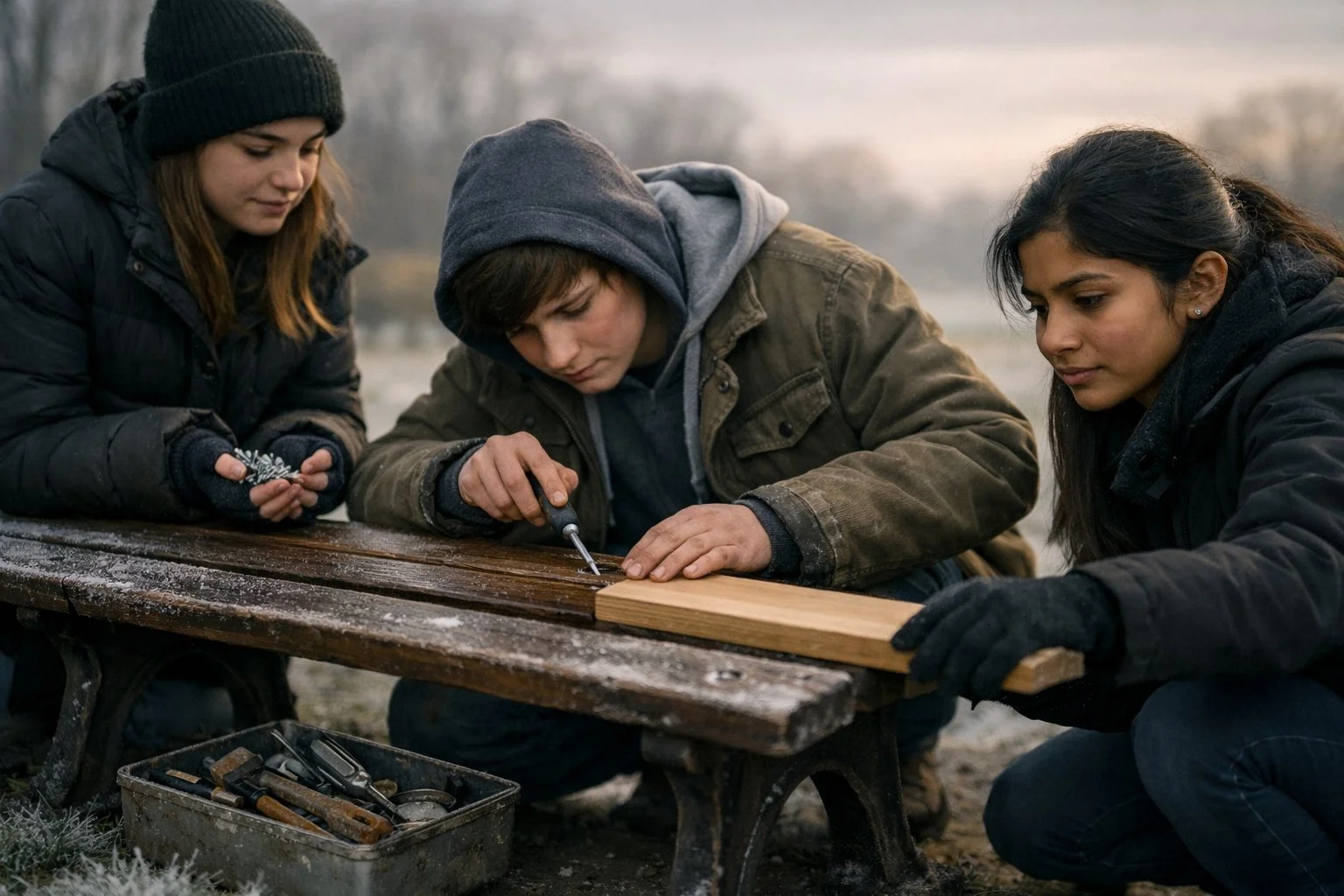
There's a bench by the bowling green that has been broken for three weeks. Someone kicked the middle slat loose and left it at an angle, and the council's laminated notice has been there almost as long. Reported. Scheduled. Which in this town tends to mean not yet, and not yet tends to mean not ever.
Leila comes through the gate a few minutes after Finn arrives. This is how she first knows he exists.
He doesn't see her. He's already working: toolbox open on the ground beside him, fitting a new slat with the focused attention of someone who has closed the world out. He's about sixteen. His hands move with a certainty that the rest of him hasn't quite caught up to yet.
I know those hands. I've watched them before, years younger, hovering at the edges of a garage while his brother and I took things apart and put them back together and laughed about things I can't quite recall now. Joel always said Finn would be better at this than either of us. He was right even then. Finn could see how things fit together before he could reliably read a clock.
Joel's toolbox is on the ground beside him. I recognise it: the dent in the top left corner from the time Joel dropped it off a wall, the streak of red paint along the side from something neither of them would ever admit to. Joel left it in the workshop behind the sports hall a long time ago, when the world changed shape and he stopped going in there. Finn found it eventually and started going in instead. I don't think either of them has spoken about this. Some things don't need saying, and some things are too large to say, and sometimes those are the same thing.
I know what you're about to ask. Please don't. Not yet.
Finn presses the slat twice with the flat of his hand to test it, closes the toolbox, and walks away without looking back. He doesn't want thanks. He's been told in enough small and cumulative ways that his kind of intelligence doesn't count, and he's started to believe it, which is the saddest kind of believing. He fixes things because it's the one place where he's never wrong, where the problem and the answer are both honest and all that's needed is the work.
Leila sits on the repaired bench for her ten minutes. She thinks about what she's just seen. A boy in the early morning, fixing something that isn't his, for people he'll never meet, walking away before anyone can notice.
There's something half-familiar in his face that she can't quite place, some resemblance to something she can't name. She doesn't chase it. She keeps it quietly, the way she keeps most things, and finds out his name later that day from a scrap of corridor conversation that wasn't meant for her.
Finn. She turns it over carefully. Files it away.
* * *
Asha you'd notice. She takes up exactly the right amount of space and doesn't apologise for it, and I've always admired that, even though I could never manage it myself. I was the quiet one, the one at the edges, the one who watched and rarely said. Asha is the opposite, and the world needs both. I understand that now better than I did.
She's fourteen, which sounds young until you understand what she's been managing. Her home life is complicated in ways she doesn't discuss with anyone, so she's turned herself outward instead, made the whole world her project, because the world is easier to fix than the place you sleep. I recognise that logic. I understand the reasoning from the inside in a way I wish I didn't.
The day of the fire she gets in trouble at school. Ryan Glover said something to Dakarai in the corridor that Dakarai didn't have the words to answer, and Asha had the words and used them, clearly and without waiting for permission. Ryan went to a teacher. Asha sat outside the head of year's office for twenty minutes and came out looking like she'd won. Which, in the way that mattered, she had. Dakarai had a voice that afternoon, even if it was Asha's, borrowed without being asked for, which is exactly the kind of help that doesn't wait for permission.
On her way home she walked past the burnt shell of Mr Patel's shop and stood in front of it for a while. Something settled in her face: the anger and the helplessness combining into something more useful than either.
That evening she put a message in the school's general year group chat. All capitals. No preamble. CLEAN-UP AT PATEL'S SHOP. SATURDAY 4PM. BRING GLOVES IF YOU HAVE THEM.
Leila stared at it for a long time. The familiar pulling feeling came back.
She went to the kitchen and found the rubber gloves under the sink.
* * *
I should tell you about the notes, because they're the most Leila thing about Leila, and because they matter more than she knows.
They started almost by accident. A girl in her English class got a low mark back and spent the rest of the lesson staring at her desk in a way Leila recognised precisely: the look of someone who'd already decided they'd known it would go wrong, who is in the process of having their worst suspicion about themselves confirmed. Leila knew that look from the inside.
She couldn't speak to her. Her voice had never been reliable in the moments that mattered. But she wrote four sentences on a folded piece of paper and left it inside the cover of the girl's textbook when she went to get her bag.
She never found out if the girl read it. She never signed it.
But something loosened in her afterwards, some knot she hadn't known was there. So she kept doing it. Notes through locker slats, left on chairs, tucked into library books. Never signed. Never dramatic, just true: that someone's drawing was worth keeping. That she'd noticed. That it mattered.
It was the only way she'd found to give someone a voice when her own wouldn't come.
I want to tell you something, while it's just us. She used to leave them for me too. Notes under my door, tucked into whatever book I'd left face-down on the sofa. She thought I didn't know they were from her. I always knew. They said things like: you don't have to be okay, but I think you are more than you think you are. Things like: I notice you. Things like: don't go quiet on me.
I never said I'd found them. I don't entirely know why.
I should have said.
* * *
Saturday. Four o'clock. You should see this.
Leila arrives first, dustpan and brush borrowed from home, and stands outside Mr Patel's shop wishing briefly and intensely that she hadn't come. The street is quiet. She's made a mistake. She's going to have to walk home feeling stupid about it for weeks.
Then Asha comes round the corner with two bin bags and a pair of gardening gloves, walking like she's always slightly ahead of wherever she's going. She sees Leila and acknowledges her, which is enough.
"Right," Asha says. "Pavement first."
They sweep. The silence between them is fine, which surprises Leila. They work around each other without getting in each other's way and after a few minutes she stops waiting for it to become awkward and just sweeps.
Then footsteps, and it's Finn. Leila looks up and there it is again: that half-recognition, the sense of a face she knows from somewhere she can't name. She almost reaches for it and then doesn't, the way you don't press a bruise.
He stops at the edge of the pavement and looks at the shop front, already assessing. Then he opens the toolbox and gets to work on the fallen sign above the doorframe, the bracket still attached on one side, the other end hanging loose.
Watch his hands. That's what Leila does. They move with the same unhesitating certainty she'd seen in the park, the problem and the solution already understood, all that's left the doing of it. He isn't performing. He isn't looking at anyone. He's just fixing the sign because it's there and because it needs fixing, and to him those two things are sufficient.
That's what it looks like sometimes, I think. Not the dramatic kind of courage. Just the quiet decision to do the thing that needs doing, with the hands you have, without waiting for conditions to improve.
They work for two hours. Mr Patel brings tea, three mugs carried carefully one at a time. He thanks them without making a production of it, which is exactly right. By six o'clock the pavement is clear and the sign is back and the broken window is neatly boarded.
They walk away in the same direction and peel off when the roads diverge. Not a team yet. But something.
Yes. I know. You're asking again. You've been patient and I appreciate it and I'm asking you to hold on just a little longer. There's more you need to see first.
* * *
Thursday of the following week. Come round the back of the sports hall.
Asha finds Finn sitting against the wall with a wooden slat in his hands, splintered clean at one end. Someone had another go at the bench. Third time now. Leila finds them both a few minutes later and stands at the edge of the scene, reading it.
Finn's face has that particular flatness of someone who has absorbed something and gone very quiet inside it. The way you go quiet when something confirms what you feared about the world and about yourself and about the point of trying.
"What's the point," he says. Not a question.
Asha says they should find out who's doing it and stop them. Finn says that's not how it works. They're both right, which is part of the problem.
Leila watches him. She can see he's not talking about the bench. She knows this from the inside. The feeling of offering the one thing you're good at and having it mean nothing. The slow erosion of the belief that you were ever worth much to begin with. The voice that says nothing you do makes any lasting difference, so why are you still doing it, why are you still here.
I know that voice too. I know it very well.
"What do you think the point is?" she says. "Of fixing things."
Finn looks at his hands.
"I think," Leila says carefully, "it might not be about whether it stays fixed. It might be about the time in between. Between when you fix it and when it breaks again. During that time someone sits on it. Someone doesn't have to walk past something broken. Your hands did that. Even if it breaks again."
She pauses.
"My brother used to say something like that," she says. "That doing the small thing was still doing something. That it was enough to help for a little while even if you couldn't help forever." She looks at the slat in Finn's hands. "He was good with his hands. Better than he thought he was."
Something shifts in Finn's face.
"He died," Leila says, in the plain careful way she's learned to say it. "Two years ago. He was seventeen."
Finn goes very still.
"What was his name?" he says quietly.
Leila looks at him, slightly surprised. "Rowan," she says.
And I can't tell you what happens to me in that moment. I don't have the language for it. I've been watching this street, this town, these three people, and I've been so busy watching that I haven't been asking certain questions. I haven't been looking at certain things directly. It's possible, I think, to know something and not know it at the same time, to feel the shape of something in the dark and choose not to turn the light on, because the watching is easier than the knowing and the knowing would change everything.
Finn says: "Joel's Rowan."
Leila stares at him.
"He was my brother's best friend," Finn says. "He used to come round all the time. He fixed my bike once. He told me I was good with my hands." He stops. His voice has gone careful. "I never forgot that. I don't think I ever told him."
I want to keep going. I want to keep watching. But something has shifted underfoot and I can't quite find the same footing I had before, and you're here, you've been here all along, and I think you already know. I think you've been asking because you knew. I think you were kinder than I was, in your way, letting me tell it at my own pace, not pushing, just staying.
Like Leila. Staying.
Let me finish the story. Then we'll talk. I promise.
* * *
I won't give you every detail of what happens when Mr Patel tries to reopen. You've been here long enough to picture it. Leila passing on her way to the library, seeing the lights on inside for the first time since the fire. The message to the group chat. Asha outside managing the queue so Mr Patel doesn't have to face it alone, finding out what each person needs, giving him his voice back before he's had to use it. Finn at the till, doing something careful and certain with a small screwdriver, the same hands that learned what they could do in a garage a long time ago.
Leila stays near Mr Patel. Not talking much. Just present, in the way that turns out to be the most important way of all.
He tells the room that he's been in this country forty years, thirty-two of them in this shop. Leila says whatever you decide, today you came back and you opened the door, and that's not nothing. The till drawer opens clean. Mr Patel stands with one hand resting on it, and that's the whole thing: one hand resting on something that works again.
"Good," he says. "Good."
Asha comes in from outside. Seven people. Two want bread, one wants milk, one wants a scratch card, three just came because they heard he was opening.
Mr Patel straightens up. "Send them in."
* * *
Sunday morning. The park. You know the bench by now.
Finn is there when Leila arrives. He shifts the toolbox without looking up, making room for her. Asha arrives two minutes later and without ceremony holds the far end of the slat while Finn works on the near end.
Leila holds the screws.
I want you to look at their hands. Really look.
Leila's hands, that have written hundreds of unsigned words for people who didn't know they were coming. That held a bottle of water out across a road she was afraid to cross. That folded themselves in her lap all those times the voice said stay small, and then unfolded again anyway.
Finn's hands, that fixed this bench before school because nobody else would, that have carried Joel's toolbox and made it their own, that learned they were good and capable from a boy in a garage who said it once without knowing it would last.
Asha's hands, that have pulled people through gaps they didn't know they could fit through, that have been steadying other people's weight since before they should have had to, that are holding the wood right now so someone else's certainty has somewhere to land.
Small hands. Not powerful. Not remarkable. But theirs. Entirely, stubbornly, defiantly theirs.
A dog goes past. A child on a scooter comes close to Asha and thinks better of it. The sun moves in and out of the clouds and when it comes out it's warm on the backs of their hands.
Finn presses the repaired slat once, twice, three times. It holds.
They stay on the bench after, the three of them, not saying what it means. The town goes on around them: a radio somewhere, a bus, a dog two streets over, the ordinary sound of a place that is continuing.
* * *
Are you still here?
Of course you are. You've been here the whole time.
I know what you want to ask me. I've known since the beginning, if I'm honest, which I'm trying to be, finally. You weren't asking out of nosiness. You were asking the way Leila responded to Finn when he said what's the point: not to catch me out, not to push me somewhere I didn't want to go, but gently, and again, and with patience, because you could see something I was trying not to look at directly. You were asking because you believed the answer might be worth something to me. That's a different thing entirely from demanding it.
Two years ago I made a choice. I thought I was doing something kind. I thought the kindest thing I could do for the people I loved was to stop being something they had to worry about, to stop being a weight they had to carry, to remove myself from the equation because the equation seemed to me to balance better without me in it.
I was wrong. I know that now in a way I couldn't seem to know it then, when the knowing would have mattered. I've spent two years watching a girl cross roads she was afraid to cross because that's what you do, because the small act is the point, because showing up for someone even imperfectly is worth more than any clean and permanent solution. I've spent two years watching a boy carry a toolbox that used to sit in Joel's garage, that now lives in a workshop behind a sports hall and is slowly becoming part of a different story. I've spent two years watching a girl I never met be brave in ways I never was, and learning from her, which is not the order these things are supposed to go in.
I thought leaving was the kindness. I understand now that staying would have been. Staying imperfect and struggling and present and mine. Crossing the road. Holding the screws.
I can't fix that. It's the one thing these hands can't touch.
But I think you already knew all of this. I think that's why you kept asking. Not to accuse me. Not to make me say it. But because you could see I needed to say it, and you were patient, and you stayed.
You stayed.
I don't know what to do with that except to say: thank you. For being here while I told it. For not leaving when the story got harder. For asking the question over and over until I was ready to answer it.
Leila is on that bench right now. She's going to be all right. She was always going to be all right, I think, but I couldn't see it from inside my own noise, and I wish with something that feels enormous that I had been able to see it, that I had stayed to find out. She crosses roads now. She holds the screws. She is so much braver than I ever told her she was, and I should have told her, every day, the way she told me in those folded notes I never admitted to finding.
She's going to be all right.
That means I can go. Not because I have to. Not because I'm fading or finished. But because staying now would be for me, and not for her, and I've only just understood the difference.
In the end, only kindness matters. That's the whole of it. Not the grand kind, not the kind that announces itself, just the daily ordinary human kind: the water bottle, the bench, the note left unsigned, the question asked gently until the answer comes.
I was someone who knew this street. I was someone who noticed things. I was someone who was more than he thought he was, and who didn't stay long enough to find that out, and who has spent two years learning it anyway, the long way round.
My name is Rowan.
And I think it's time to go.








For three years Neil shared a morning commute and never noticed the choreography that held it together. Four years after the world stopped, a closed road puts him back on the old platform, where his hands remember something his mind let go of. A story about who we stop seeing.