
Locking Doors
ACT I: THE RITUAL OF SAFETY
Raymond — 2026
The deadbolt goes in at twenty-two minutes past ten.
I have counted. I have always counted. There is the Yale first: a quarter-turn clockwise, the satisfying thunk of the mechanism seating itself, and then the deadbolt, which requires the full rotation, which requires that I feel the resistance before I release the key, because releasing before the resistance means it hasn't caught, and if it hasn't caught then the door is not locked, and if the door is not locked—
I start again.
Yale. Quarter-turn. Thunk.
Deadbolt. Full rotation. Resistance. Release.
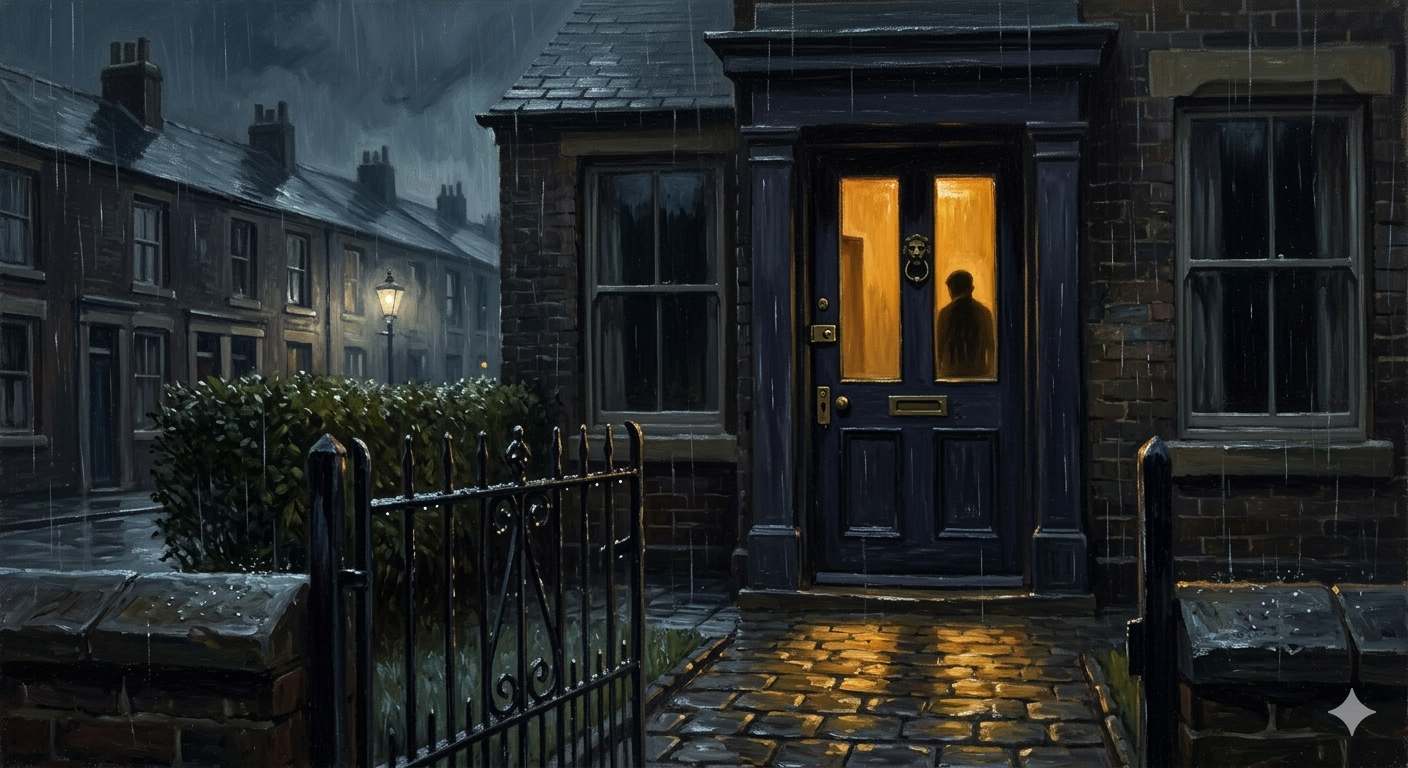
I press the flat of my palm against the door. Cold gloss paint, slightly tacky from the rain that has come in off the street all evening, plastering the leaves of the privet against the iron gate. I count to five. The door does not move. The door cannot move. I have made certain of this.
I look, as I always do, at my left hand.
The ring has been gone for twenty-seven years. The skin where it sat is the same as all the other skin now. I look anyway.
The hallway of Number 12 receives me with its usual neutrality: the coat rack, the telephone table, the framed print of Scarborough I bought in a charity shop because it had nothing to do with anything, which is the only quality I have ever required of art. On the floor, the runner of patterned red carpet reaches toward the kitchen, worn pale down its centre by thirty-five years of feet. At the foot of the stairs, the good slippers are not there. I make myself look at the place where they are not, the way you make yourself press a bruise: not from cruelty, but to establish that the pain is real, that the thing that caused it actually happened.
She has been gone six weeks.
I clench my jaw against nothing in particular. It clicks at the hinge just below my left ear, and I feel the familiar pressure release.
I do the back door. Then the kitchen window. Then I stand in the centre of the kitchen and breathe, and the house settles around me the way it always does, and I am safe. Whatever that means. Whatever it has ever meant, to any of us, inside these walls.
Then I go upstairs and do what I have been doing every night since she died: I stand outside her door. I do not open it. I press my palm flat against the painted wood and count to five, and the door does not move, and that is as close as I can get, tonight, to whatever it is I am trying to say.
* * *
ACT II: THE ORIGIN
Finn — 1996
The wardrobe smelled of mothballs and the ghost of my father's good coat, which had hung there when he still had occasion to wear it.
I was eight, and I had worked out, with the methodical logic of a child who has learned to rely entirely on himself, that if I pulled the wardrobe door so that it rested against the latch without clicking shut, I could breathe without it sounding like breathing, and I could see the thin orange line of the landing light under my bedroom door, which told me if anyone was coming.
No one was coming.
Three steps along the landing, behind the door with the Paddington Bear sticker she had never taken down, my sister had retreated into her particular silence an hour ago. I knew the quality of it. It was not the silence of sleep. It was the silence of a person deciding not to make any noise, which is a different thing entirely, and she had been practising it since before I had a name for what we were both doing.
They were downstairs.
I knew the topography of their voices the way a sailor knows weather. My mother's started low and climbed, a pressure system building, finding its shape. My father's went the other direction, dropping toward something flat and implacable that was somehow worse than shouting. Between them, the house filled up with a substance that wasn't quite sound and wasn't quite silence. It got into the gaps between the floorboards. It came up through the carpet.
I had locked my bedroom door.
I'd asked three weeks ago, standing in the kitchen doorway. My mother had looked at me with an expression I didn't have a word for yet. I would find the word in my thirties, when I was paying a woman in a consulting room to help me excavate exactly this. She had said: I'll ask your dad.
He came on the Saturday. I sat on the bed and watched. He didn't look at me, not directly, but I watched his hands: large and careful, measuring twice before every mark, the pencil line so precise it barely existed. He fitted the latch plate first, then the barrel, testing the action four times before he was satisfied. When he was done he stood, and I saw his jaw tighten and release with that small click I had known all my life, the sound that lived just below his left ear, the sound I associated with the moment before silence.
He left without saying much. Something like: there you go. Something like: your own space now.
I didn't understand then that he was apologising. I thought he was solving the problem. I spent the next twenty years making the same mistake he had: confusing a lock with an answer.
In the wardrobe, I turned the small brass key over and over between my fingers. I ran my tongue across the gap between my front teeth, the private inventory: still here, still me. The sound downstairs was smaller now, behind the locked door, and I told myself that smaller was the same as gone.
It wasn't. But it was enough to get through the night, and at eight years old a night is the only unit of time that matters.
* * *
ACT III: THE THRESHOLD
Mara — 2003
The thing about my father was that he believed a locked door was an act of hostility.
I had watched him for twenty-one years. I had studied him the way you study a climate: not because you love it, not because you don't, but because it determines what you can and can't do on any given day. I knew that when he locked a door it was care. It was protection. It was love expressed in the only language he had ever been taught. I knew that. I had always known that, and the knowing of it did nothing whatsoever to make me feel less like a specimen in a jar.
I had my mother's colouring but my father's eyes: one part grey, one part green, as though two people had failed to agree on something fundamental and I was the result. I had read once that this kind of iris was a fault in the pigmentation, some miscommunication at the cellular level. I had cut that page from a library book and kept it in my drawer for a week before I understood why, and then I had thrown it away.
The diary was purple, with a small brass clasp that was decorative rather than functional. I had sellotaped it shut anyway. I had written PRIVATE on the cover in black marker, and then, because the emphasis felt insufficient, PRIVATE MEANS PRIVATE. It lived behind my copy of Wuthering Heights on the second shelf, which I had selected because it was the only book there my father had no reason to touch, being a man who had not read fiction since 1987 and was not planning to resume.
I wrote in it every night. I always had ink on the side of my left hand from writing, a blue-grey smear at the base of my little finger that I had long since stopped trying to wash off. I wrote about the job in Sheffield I had already accepted without telling anyone, and the flat I had already viewed, and the date six weeks from now when I intended to put Hallowford in the wing mirror and not look back for as long as I could manage. I wrote about my mother, who had been gone for four years and whose absence had settled into the house like a new load-bearing wall: structural, invisible, not to be discussed.
I wrote: He checks the locks in a certain order. Yale, deadbolt, back door, kitchen window. I've counted. If I stay up late enough I can hear him. Click. Click. Click. Like he's trying to keep something out that is already in here with us.
I stopped. Looked at the sentence. Felt something shift in my chest that I couldn't name and didn't try to.
Three steps along the landing, a door opened and closed. The particular softness of someone who has been practising it for years. My brother was fifteen and had perfected the art of moving through this house without disturbing its atmosphere. We did not talk, he and I, not about the things that mattered. We had an arrangement that required no discussion: he disappeared in one direction, I disappeared in another, and between us we covered the whole architecture of the house without ever quite meeting in the middle. I had taught him that, or the house had, or our father had. By now it was impossible to separate the curriculum from the teacher.
I sellotaped the diary shut and lay on my bed staring at the ceiling, listening for my father below me. From the kitchen came no sound at all, only the silence of a man moving through his ritual, and I could picture it so precisely it was almost the same as hearing it: the click of his jaw at the hinge just below his left ear, the small percussion of a man holding himself together by force of will alone. I had watched him at the dinner table often enough to carry the image in my body. I could have reproduced it from memory in a dark room. Perhaps that is what it means to know a person: not that you can hear them, but that their habits have become so interior to you that the wall between you makes no difference.
The decision I made in the next ten minutes was not dramatic. From the inside it felt like setting down a weight I hadn't known I was carrying.
I decided not to come back. Not really. Not in the way that mattered. I would phone, and visit at Christmas, and answer his questions about the job, and mean some percentage of all of it. He would never know that somewhere in the March of my twenty-first year I had installed a deadbolt in the middle of my chest and thrown the key somewhere I couldn't follow.
I was, I told myself, keeping myself safe.
I was, I would understand later, when I was standing in a flat in Sheffield trying to explain to someone who loved me why I couldn't let him in: locking myself in. The same as my father. The same as his mother, perhaps, before him. An inheritance passed down through the blood like a fault in the pigmentation, like a pair of mismatched eyes reproduced in every generation, two people failing to agree endlessly in the faces of their children.
I caught my reflection in the dark window above the desk. One part grey, one part green.
I closed the curtain on it and went to bed. The ink on my hand was still wet.
* * *
ACT IV: THE UNLOCKING
Edith — 2025
The doors in this house talked to me, but I had not yet learned all of their words.
In my own house, the house where I had raised my children and grown old alongside Geoffrey, every door had its particular voice. The front door spoke in a dry low rasp that meant winter and home and someone arriving out of the cold. The bathroom door swelled in summer and required a shoulder. The door to Thomas's room made no sound at all, because I had oiled its hinges the week after the funeral and kept them oiled for forty years, and in all those years I had not once opened it in the dark.
Here at Number 12, I was still learning.
I stood in the upstairs hallway at two in the morning in my nightdress and my good slippers, not entirely certain how I had come to be there. I remembered lying down. I remembered the lamp going off. Between those things and this landing there was a gap of the kind that had been appearing more frequently: not blackness, not sleep, just absence. A door that opened onto nothing.
I was looking for Thomas.
The first door I tried was not mine. The handle was wrong, too low, too cold. I opened it anyway.
A boy's room. Not Thomas's room, and yet I stood in the doorway convinced for a moment that it was, convinced by something older than reason. The room had the specific stillness of a space that has been waiting a long time. A single bed. A chest of drawers with the top drawer not quite closed. A poster on the wall, half-curled at one corner, something bright and astronomical. On the bookshelf, a row of paperbacks with broken spines, loved to pieces in the way of boys' books.
Then I saw the lock.
It was on the inside of the door: a small barrel lock, the kind I associated with bathrooms and the need for privacy. I stood looking at it for a long time. I thought about the kind of night that would make a child ask for a lock on their bedroom door. I thought about what it would mean to be the parent who fitted it. Whether it would feel like protection or like failure, or whether, in the end, those were the same thing seen from different sides of the same door.
The wardrobe was slightly open. I touched the door and it swung inward, releasing the smell of old wool and something floral and chemical I recognised before I named it. Mothballs. And beneath that, fainter, the ghost of a coat that had been hung there when its owner still had occasion to wear it. The rail was empty now except for two wire hangers turning slowly in the disturbance of the door.
I closed the wardrobe. I went back to the landing.
The next door along. I opened it.
A girl's room, and I knew before I could have said why: something in the arrangement, something in the objects on the small desk, a particular quality of order that was also a particular quality of pressure, everything placed just so by someone who had needed to control at least this much. A bookshelf above the desk. I moved toward it without deciding to, the way you move toward something in a room when you are not quite sure what you are looking for.
I ran my finger along the spines. I was not reading the titles. I was doing something else, something half-remembered, the way you can still find your way around a town you have not visited in forty years because the body knows before the mind catches up.
My finger stopped.
Wuthering Heights. A school edition, the cover worn to a soft grey at the corners. I took it down, and behind it, where the shelf had been two books deep, there was a small purple notebook. I looked at it. On the cover, in black marker, in the handwriting of someone young and entirely certain: PRIVATE. PRIVATE MEANS PRIVATE.
I held it for a long time.
I thought about the things I had put away over the years. The whole careful geography of the unsayable. Thomas's birthday, which fell in April, which I had spent forty years finding other things to do in April. Geoffrey's last months, which I had filed so precisely behind the part of me that still needed to function that I sometimes forgot, for whole stretches of hours, that he was gone. The things I had looked at so often that they had lost their edges and become smooth and manageable and no longer quite real.
Whoever had written PRIVATE MEANS PRIVATE on this cover had understood something. Had understood it at an age when the understanding cost something.
I put the notebook back behind the Brontë. I replaced the novel in front of it. I took my finger away.
"Mum."
Raymond, on the landing behind me. I turned. He was in his dressing gown, his face doing the thing it always did: assembling concern into something he could manage.
His eyes in the half-dark were one part grey, one part green. The same as they had always been. The same as mine.
"You should be in bed," I said.
"So should you." He came to me gently, the way you approach something that might startle. "What are you looking for?"
I turned my wedding ring with my thumb. I felt the thin underside, the almost-nothing, the gold worn down by fifty-two years of the same movement, by all the ordinary days that had accumulated into a life I had not always known how to live inside.
I thought about the lock on the door in the first room. The notebook behind the book. The things this family had filed away and called survival.
"Thomas," I said.
He went very still.
We had not said this word. Not in all the years I had been here, not in all the years before. We had built everything on the load-bearing silence of it, every Sunday dinner and ordinary Tuesday, and here I was, with my doors coming open in the night, saying it plainly on a landing at two in the morning. And my son was standing in front of me with his arms at his sides and his face doing something I had not seen it do since he was a boy.
It was opening.
"I know," he said. His voice was very low. "I know, Mum."
I reached for his hand and he let me take it. I felt the bare patch of skin where his ring had been, smooth and unremarkable now, twenty-seven years of absence worn into something approaching acceptance. I held it anyway. I turned my own ring with my thumb, the thick part and the almost-nothing, and I thought: some things wear down and keep going. Some things wear down and hold.
Behind us, the landing held its breath.
* * *
ACT V: THE RETURN
Mara — 2026
The train from Sheffield took an hour and forty minutes.
I had made that journey enough times in the early years to stop counting, and then gradually I had started counting again, in the other direction: the Christmases I had arranged good reasons to miss, the phone calls I had returned the next day with a performance of lightness so practised I had, somewhere along the way, lost the ability to tell it apart from the real thing.
The house was the same. It was always the same. That was the thing about my father and Number 12 that I had spent twenty-three years deciding how to feel about: nothing was ever changed, nothing was moved, nothing was allowed to become other than what it had been, as though the act of alteration was itself a kind of loss he could not afford.
He met me at the door. We held each other in the way we had learned to, the brief tight compression of two people who share something inarticulate. He looked thinner. His jaw clicked as he pulled back, just below his left ear, the sound I had written about in a purple notebook two decades ago.
He made tea. We talked about the arrangements, the practical geography of grief: who had been told, what the solicitor had said, what could wait. We talked for forty minutes about everything except the thing we were both sitting inside.
Then he said he was going to lie down for a while, and I said I would be up shortly, and he went, and I sat in the kitchen with the cooling tea and the particular silence of a house that has recently lost someone who moved through it.
After a while I went upstairs.
Passing along the landing, I saw the Paddington Bear sticker still on my door, faded but present, which stopped me for a moment. Then I saw, on the door next to it, the small brass lock: fitted on a Saturday morning a long time ago, never removed. I stood looking at it. I thought about my brother at eight years old, and the sounds that had come up through the floorboards, and all the ways we had each found to make ourselves smaller until smaller felt like safety. I did not go in. I moved on to my own door.
My room was unchanged. I stood in the doorway and looked at it the way you look at a very old photograph of yourself: recognising the subject, uncertain about the relationship. The curtains I had chosen at sixteen, dark blue with a thin white stripe. The desk with its faint blue shadow of old ink at the right corner, where I had rested my hand ten thousand times.
I went to the bookshelf.
Wuthering Heights was where I had left it. Of course it was. I took it down. Behind it, slightly flattened against the back of the shelf, the purple notebook with its yellowed sellotape and its black marker insistence: PRIVATE. PRIVATE MEANS PRIVATE.
I sat on the bed with it in my lap.
The sellotape came away without resistance, which felt like something. I opened it.
The handwriting was mine and not mine: the letters rounder, slightly unformed, the hand of someone still deciding what kind of person she was going to be. The ink had faded to a brownish grey. I turned the pages slowly. The job in Sheffield. My mother's absence described with a precision that surprised me, a quality of attention I had not known I possessed at twenty-one.
And then the passage about the locks.
He checks the locks in a certain order. Yale, deadbolt, back door, kitchen window. I've counted. If I stay up late enough I can hear him. Click. Click. Click. Like he's trying to keep something out that is already in here with us.
I read it twice. Then I sat for a long time with the notebook open on that page.
I had written this at twenty-one and believed I was writing about my father's failure. I understood now, at forty-four, that I had been writing about his grief. That the click of the deadbolt and the click of his jaw and the bare patch on his left hand where the ring had been were all the same sentence, spoken in the only register available to him. I had understood this even then, understood it clearly enough to set it down, and I had chosen, because I was twenty-one and it was easier, to treat the understanding as a verdict rather than an opening.
I closed the notebook. I did not sellotape it shut.
I went downstairs.
My father was not in bed. He was sitting at the kitchen table with his hands flat on it, his left hand turned palm-up as though checking for rain. The bare patch of skin. The same as always.
I sat down across from him.
I did not know what I was going to say. I had spent twenty-three years not saying things, and the muscles required for the alternative had atrophied, and I was aware of the real possibility that whatever came out would be the wrong shape, would fail the occasion entirely.
"I read something I wrote," I said. "A long time ago. About you."
He looked up.
"It wasn't unkind," I said. "I want you to know that."
He looked at me with his grey-green eyes, the same as mine, the same fault in the same pigmentation, and his jaw clicked once at the hinge below his left ear. Then he nodded.
We sat there. The house settled around us. Outside, Hallowford was doing what it always did at this hour: the rain finding the gutters, the street going quiet, the dark coming down steadily in the way of northern towns that have never expected anything different.
We were not fixed. But we were in the same room, with the same silence, and for the first time in a very long time the silence did not feel like a wall.
* * *
CODA
Finn — 2026
I came up from Leeds on the train on a Saturday in March, through a landscape that shifted from terraced brick to open moor and back again, the sky doing what northern skies do in March: failing to commit, the light neither winter nor spring but somewhere uncertain between the two, as though the year had not yet decided what it was trying to become.
Hallowford station smelled of diesel and wet platform and the specific compound of chip fat and old cigarette smoke that I associated, at a cellular level, with the idea of home. An idea I had spent most of my adult life treating as a problem to be solved rather than a place to return to.
I walked from the station to Cartwright Terrace.
Number 12 was exactly as I had last seen it, seventeen years ago when I had left without quite deciding to leave: the privet, the iron gate that still caught if you didn't lift it slightly as you pushed, the front door with its brass knocker going green at the edges from years of weather.
The door was not fully closed.
I stood on the step and held the key my father had sent six weeks ago, in an envelope with no note, only the key, which I understood to mean: she's gone and I don't know what else to say and here you are. The key was heavy and old and warm from my pocket, and I looked at the gap of dark between the door and its frame and understood that someone had already done what I had come here to do.
The door was dark enough that I could see myself in it, faintly, in the way dark glass returns you to yourself when the outside light is failing. The gap between my front teeth, which I had been running my tongue across since the station without noticing. The shape of my face.
My father's face. My sister's face. The same eyes looking back: one part grey, one part green, the same miscommunication reproduced in every generation, two people failing to agree all the way back to wherever it started, the fault in the pigmentation carried forward through all of us, this thing we had inherited and never chosen and never, until now, quite named.
I pushed the door open and stepped through and left it as I found it.
The draught excluder brushed the mat with its soft shush: the sound of someone arriving, the sound of cold air and the smell of the street and the ordinary grace of coming home, a sound this house had been making for longer than any of us had been inside it.
From the kitchen came voices.
Not the low controlled violence of a marriage in the process of failing. Not the particular silence of people deciding not to make any noise. Two voices in the register of people who are saying, carefully and haltingly, the things they have not said before, and finding that the ceiling holds, that the floor holds, that a thing spoken plainly does not bring the room down. My father's voice, low and slow, with the long pauses of a man working muscles he has not used in a long time. My sister's voice, steadier than I had heard it in years, with the quality of attention I recognised from childhood: the quality of someone who has been paying close attention to the wrong things for a very long time and has finally, at last, turned it toward the right one.
I stood in the hallway and let the cold move through it.
I ran my tongue across the gap between my teeth. Still here. Still the same.
I thought about a Saturday morning in 1996, large and careful hands, a lock fitted in silence, and all the things that silence contains when a man has no other language for what he is trying to say. I thought about everything in this house that had been sealed and filed and set aside over the years, and all of us moving through it, each in our own direction, each convinced we were protecting something.
I thought about my grandmother, who was gone now, and whose hands had turned a wedding ring for more than fifty years, and who had said one word on a landing in the small hours of a night I had not been there for. Just a name, apparently. And the ceiling had held.
I did not call out.
I walked toward the kitchen.
I did not reach back for the door.
* * *
Outside, Hallowford went on in its grey and patient way, the street lamps coming on one by one in the early dark, the rain beginning again as it always did: quietly, without announcement, as though it had never stopped. A door left open is not a house unprotected. It is a house that has decided, at last, that whatever has been outside and whatever has been inside have been strangers to each other long enough.










Two girls have named the clouds over Hampstead Heath since they were nine. The summer they turn sixteen, a dazzling first love and a quiet family catastrophe pull them apart. A story about idealism, the hard winter that follows it, and learning what it costs to turn back up for someone.